This guide connects affiliate-toolkit to the Amazon Associates program. Once the Amazon shop is set up, you can search Amazon from your WordPress backend, import products by keyword or ASIN, build bestseller and search lists and keep prices up to date automatically.
You need:
- affiliate-toolkit installed and activated (see Installation of affiliate-toolkit). The Amazon interface ships with the version from the WordPress plugin directory; with the full version you install the Amazon module, which is included in every pass.
- An Amazon Associates account for the marketplace you want to promote, with a tracking ID.
- Either access to an Amazon API (Creators API or Product Advertising API) or the Amazon No-API mode extension.
Choose your data source
Every Amazon shop in affiliate-toolkit gets its product data from one of three sources. You pick it at the top of the shop under Select Data Source:
| Data source | What you need | When to use it |
|---|---|---|
| Amazon Creators API | Credential ID and Credential Secret from Associates Central | The new official Amazon API with OAuth 2.0. Amazon is replacing the Product Advertising API with it, so use it for every new setup. |
| Amazon Product Advertising API | Access Key ID and Secret Access Key (PA-API 5.0) | Existing setups that already have working PA-API keys. |
| No-API Mode | The Amazon No-API mode extension with an active license | New Associates accounts without API access, or accounts that lost access because of missing sales. |
Whichever source you choose, the marketplace, tracking ID and the other shop options below stay the same, so you can switch the data source later without touching your products.
Get Creators API credentials
The Creators API uses a Credential ID and a Credential Secret instead of the old access keys. You create them in your Amazon Associates account (Associates Central). Amazon explains the steps in its Creators API help page.
Write down the credential version as well. affiliate-toolkit supports the versions 2.1 (North America), 2.2 (Europe), 2.3 (Far East) and their Login with Amazon variants 3.1, 3.2 and 3.3. The version has to match the region of your marketplace and the type of credentials Amazon issued.
Keep the Credential Secret in a safe place. Like most API secrets, it is usually shown only once when you create it.
Get Product Advertising API credentials
If you still use the Product Advertising API, log in to Associates Central and open Tools → Product Advertising API. Click Add Credentials at the bottom of the page.
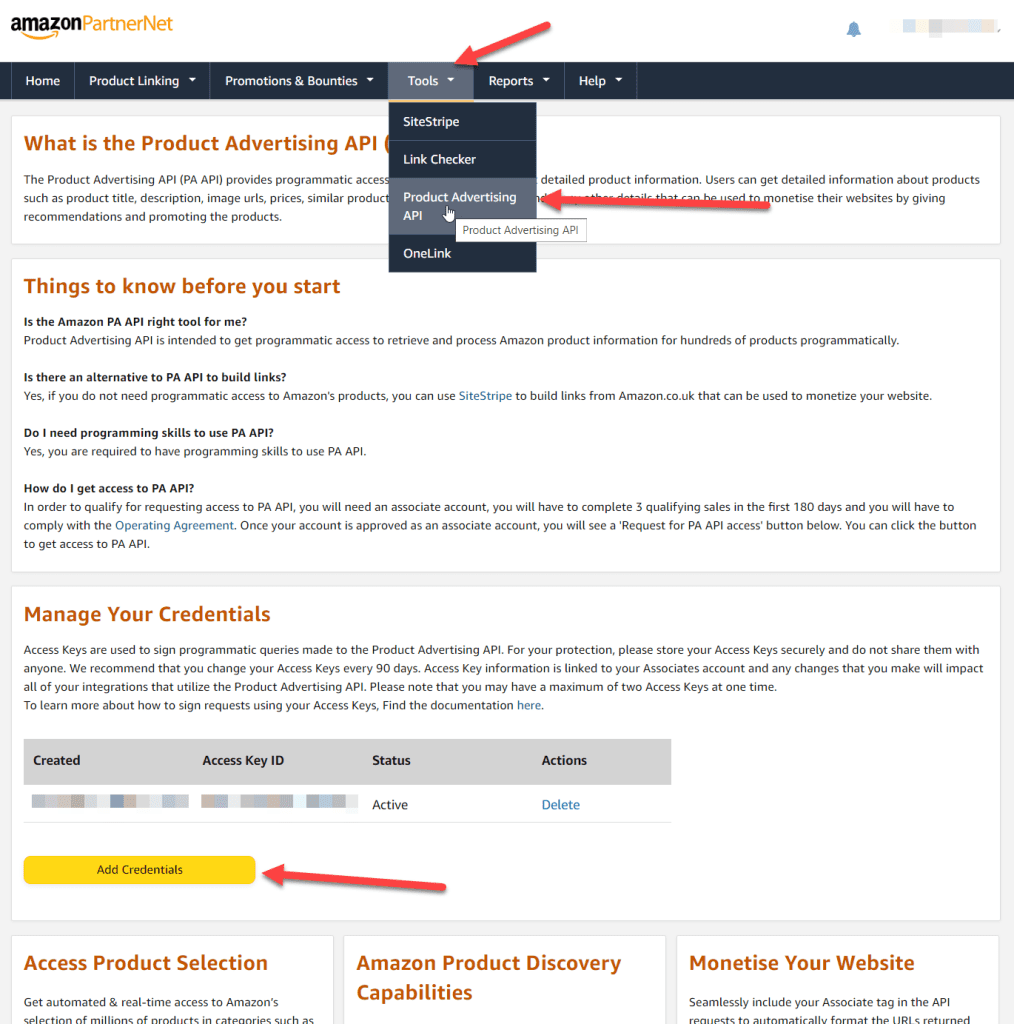
Amazon then shows your Access Key and Secret Key and offers them as a CSV download. Download the file and keep it safe: the secret key is not shown again. If you lose it, delete the key in the overview and create a new one.
You can create sub-accounts (additional stores) in Amazon Associates, but the Add Credentials button is only available in the main account.
Requirements and limits of the Amazon API
Amazon only grants API access to active Associates. New accounts get access once the website has been approved and has generated at least 3 qualified sales. Sales to your own customer account do not count. A newly created key can take up to 48 hours before it works.
For the Product Advertising API, Amazon applies these limits:
- First 30 days: 1 request per second and at most 8,640 requests per day.
- After that, based on revenue: 1 additional request per day for every USD 0.05 of shipped item revenue and 1 request per second for every USD 4,320 of shipped item revenue, up to 10 requests per second. Amazon always looks at the last 30 days.
- No sales, no access: if your account has not generated qualified referred sales for 30 days in a row, it loses API access. Access returns within 2 days after referred sales have shipped.
When a limit is hit, Amazon answers with TooManyRequests. The section Known errors below explains this and other messages.
Create the Amazon shop
- Go to affiliate-toolkit → Shops and click Add new Shop.
- Enter a title. It is only used in the backend.
- Under Data supplier, select Amazon Product Advertising API. This entry stands for all three Amazon data sources.
- Under Select Data Source, choose Creators API, Product Advertising API or No-API mode and fill in the fields shown for it.
- Select your Amazon Website (marketplace) and enter your Amazon Tracking ID.
- Click Publish. affiliate-toolkit sends a test search to Amazon. If everything is correct, Status shows Connected; otherwise you see Not connected with Amazon's error message.

Fields of the Amazon shop
| Field | Description |
|---|---|
| Credential ID / Credential Secret (required) | Creators API only: your credentials from Associates Central. |
| Credential Version | Creators API only: 2.1 (NA), 2.2 (EU), 2.3 (FE), 3.1 (NA LWA), 3.2 (EU LWA) or 3.3 (FE LWA). |
| Amazon Access Key ID / Amazon Secret Access Key (required) | Product Advertising API only: the keys from Tools → Product Advertising API → Manage Your Credentials. |
| ASIN Data API Key (optional) | No-API mode only: your own key for unlimited requests, see Amazon No-API mode. |
| Amazon Website (required) | The marketplace: Germany, United States, United Kingdom, Canada, France, Japan, Italy, Spain, India, Brazil, Australia, Mexico, Turkey, Belgium, United Arab Emirates, Netherlands or Poland. Each marketplace needs its own Associates account and tracking ID, so create one shop per country. |
| Amazon Tracking ID (required) | The tracking ID that is added to every link. It must belong to your Associates account for this marketplace. |
| Languages Of Preference | Optional, comma separated list of languages you want to receive, for example de_DE. The valid languages per marketplace are listed in Amazon's locale reference. |
| Small image size / Medium image size | Width in pixels of the small and medium product images. The defaults are 75 px and 160 px, the maximum is 1,000 px. Already imported products show the new size after their next update. |
| Product condition | Only load offers in a certain condition: Any (default), New, Used, Collectible or Refurbished. |
| Wait x seconds before sending the request | Pause between two requests, 1 second by default (maximum 20). Increase it only if Amazon returns throttling errors; more than 5 seconds is rarely useful. |
| Load variations for products | Also loads the variations of a product, for example sizes or colours. This costs one extra request per product, so only enable it if you need it. |
| Star Ratings | No-API mode only: reads star ratings from the Amazon product pages. This is not officially allowed by Amazon and is not recommended. |
Use the No-API mode
If you do not have API access yet, the No-API mode loads product data without the official Amazon API. It needs the Amazon No-API mode extension with an active license; without it, the option is marked as purchase required.
Select No-API Mode as data source, choose the marketplace and enter your tracking ID. A request contingent is included in your license; for unlimited requests you can add your own ASIN Data API key.

Setup, request limits and the differences to the API are covered in Amazon No-API mode.
The old SiteStripe-based mode no longer works because Amazon shut down SiteStripe. If you still embed SiteStripe links in your posts, read Compatibility mode for Amazon SiteStripe.
Import products in the backend
The quickest way to get products is the product import. Open affiliate-toolkit → Product import, select your Amazon shop and search by keyword, ASIN or EAN.

Tick the products you want and import them. They are saved as affiliate-toolkit products and updated automatically from then on. A step-by-step walkthrough is in How to import and display your first product.
Add a product by its ASIN
If you already have the product open on Amazon, copy its ASIN. You find it in the product details of every Amazon product page.
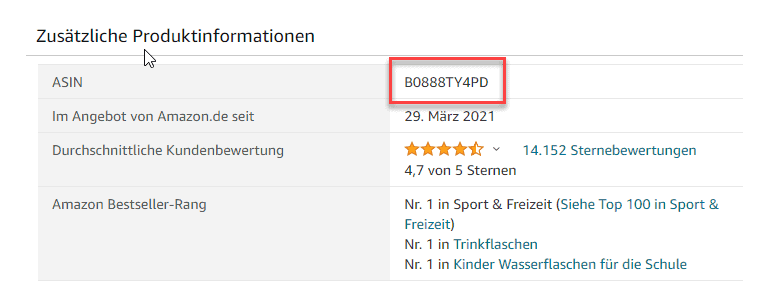
Then go to affiliate-toolkit → Products → Add new Product, select your Amazon shop, paste the ASIN into the search and pick the product. After saving, the offer appears under Products found and the product is available in your product database.
Create bestseller, new release and search lists
A list is a group of products that affiliate-toolkit keeps up to date for you. Amazon shops support four list types: bestsellers, new releases, search and advanced search. How lists work in general is explained in How to import and display your first list.
Bestseller and new release lists need the browse node ID of an Amazon category. You can search for it directly in the list form, or take it from the address bar of the bestseller page on Amazon. In https://www.amazon.de/gp/bestsellers/books/467492/, for example, the browse node ID is 467492.

Advanced search
The advanced search combines several filters of the Amazon API, for example Keywords, SearchIndex, BrowseNode, Brand, Author, Actor, Artist, Title, Condition, Availability, Minimum price, Maximum price, Min Reviews Rating, Min percentage off, Merchant Id, DeliveryFlags and Sort. It needs some understanding of the API. All parameters are described in Amazon's SearchItems documentation.
Check whether your API key works
The Status field of the shop is your first check: after saving it shows Connected or Not connected together with the error message from Amazon.
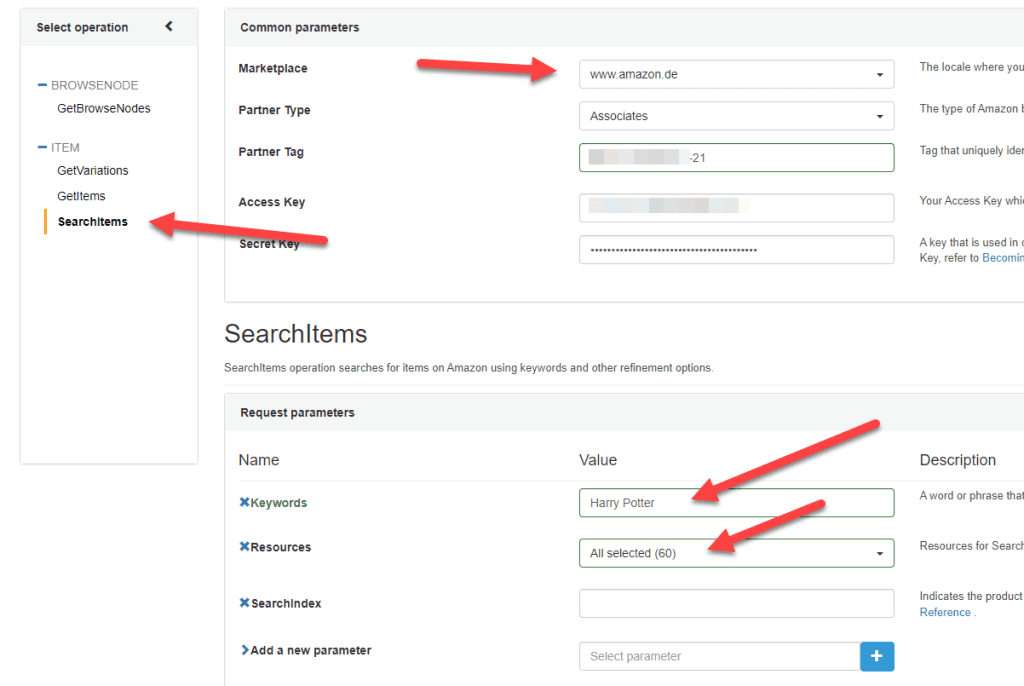
For Product Advertising API keys, Amazon's official Scratchpad gives more detailed error messages. Select SearchItems on the left, fill in your credentials, marketplace and tracking ID, enter a search term and send the request. You either get products back or an exact error.
Known errors
These are the messages you see most often in the shop status or in the logs.
| Message | Cause | What to do |
|---|---|---|
Credientials are empty | Product Advertising API is selected but the access key or secret key is missing. | Enter both keys or choose another data source. |
Creators API Credentials are empty | Creators API is selected but the Credential ID or Secret is missing. | Enter both values. |
item count is null | The test search for "Harry Potter" returned no results. | Check the marketplace and the Languages Of Preference field. |
TooManyRequests | Request throttling: the daily or per-second limit is used up, or the account had no qualified sales in the last 30 days. | Wait, raise the waiting time between requests and check your sales in Associates Central. Use the No-API mode until access is back. |
AssociateNotEligible | The account does not (yet) meet Amazon's requirements for API access. | Generate the required sales first, or use the No-API mode. |
InvalidAssociate | The keys are not linked to an approved Associates account for this marketplace. | Check the marketplace and create the keys in the main account of that marketplace. |
InvalidPartnerTag | The tracking ID is wrong or does not belong to the account. | Copy the tracking ID again from Associates Central. |
UnrecognizedClient, InvalidSignature, IncompleteSignature | The access key or secret is wrong, was deleted or is not active yet. | Check for typos and spaces, wait up to 48 hours after creating a key, or create a new key. |
ItemNotAccessible | Amazon does not provide this product through the API. | Choose another product; this cannot be changed in affiliate-toolkit. |
If a problem remains, collect the debug information as described in How to get debug information for support and contact us.
What is the SearchIndex?
The SearchIndex is the top-level Amazon category, for example Books, Music or Home & Kitchen. The browse nodes are the subcategories below it.
What do I need the SearchIndex for?
Some search filters only work within a category, such as the genre in the music category. A search across all categories is only possible to a limited extent.
Where can I find the valid SearchIndex values?
They differ per marketplace. Amazon lists them in the locale reference; choose your country there.
Can I enter several search terms in the keyword field?
No. Amazon treats the keyword field as one search phrase; there is no separator for several independent terms. Create one list per term instead.
Do I need one shop per Amazon country?
Yes. Each marketplace has its own Associates account, tracking ID and API access, so you create a separate Amazon shop for each country.